I also organize international, and inter-disciplinary events that are open to the public including workshops, seminars, and conferences. Most recently, these include:
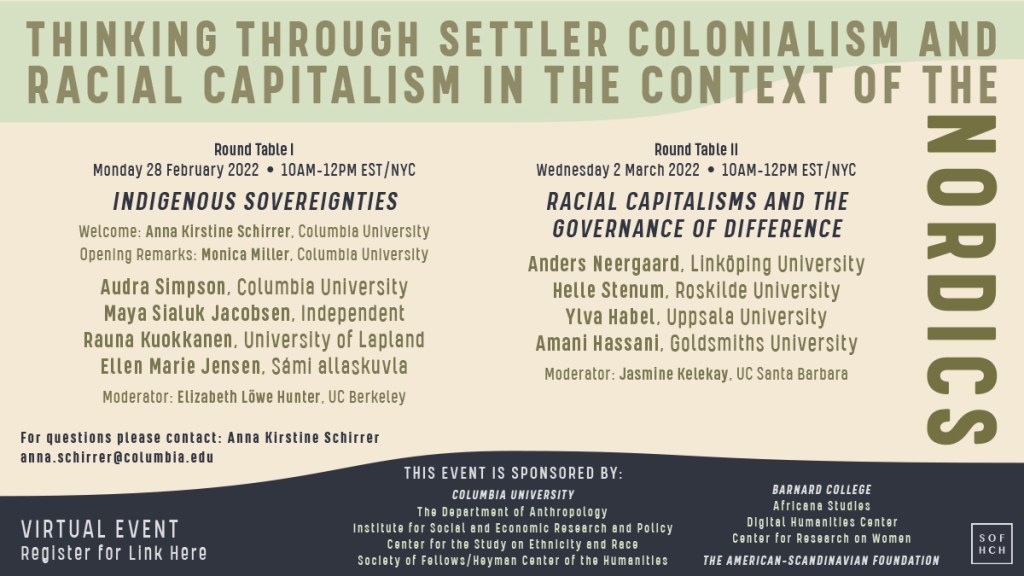
This event is sponsored by the American Scandinavian Foundation Public Project Grant. At Columbia University this event is sponsored by the Center for the Study on Race and Ethnicity; Department of Anthropology & The Institute for Social and Economic Research and Policy; The Society of Fellows and the Heyman Center of Humanities. At Barnard College this event is sponsored by the Center for Digital Humanities; the Center for Research on Women, and Africana Studies.
In late February and early March of 2022, I arranged and hosted a two day round table event entitled “Thinking Through Settler Colonialism and Racial Capitalism in the Context of the Nordics” at Columbia University. Scholars in this round table discussion thought through the terms of racial capitalism and settler colonialism in relation to their own work and in the context of the Nordics exploring the racial logics of transnational and transhistorical disciplinary regimes. What are the possibilities and limitations of thinking through these terms in an attempt to understand the long durée of Native dispossession, anti-Blackness, and neo-colonial/imperialist global inequalities in the Nordic region today?

In 2020, I co-organized a six week long international online conference entitled “On the Possibility and Impossibility of Reparations for Colonialism and Slavery” with my colleague and collaborator Howie Rechavia Taylor. This webinar series investigated the significance of a global turn towards demands for reparatory justice for slavery and colonialism, and probed the terms upon which reparations would be capable of both enacting repair and accounting for social inequality in capitalist, white supremacist, and settler colonial contexts. Acknowledging the global implications of racialized forms of oppression, the series prioritized an international framing of the question of reparatory justice and asked participants to ponder the possibility and the impossibility of reparations for slavery and colonialism.
This event was sponsored by the Heyman Center for the Humanities/Society of Fellows; The Institute for Social and Economic Research and Policy: ISERP, and the Department of Anthropology at Columbia University.
 Anna Kirstine Schirrer